2026 Best Air-Purifying Plants for Apartments: 6 NASA-Tested Picks That Actually Survive
Living in an apartment doesn’t mean you can’t breathe cleaner air. The NASA Clean Air Study (1989) identified dozens of common houseplants that remove volatile organic compounds — formaldehyde, benzene, trichloroethylene — from indoor air. But not all “air-purifying” plants survive real apartment conditions: low light, dry HVAC air, inconsistent watering, and cats who treat leaves like chew toys.
This guide covers 6 plants that pass both the NASA test and the apartment survival test. All are available on Amazon US with specific ASINs. Prices are current as of June 2026.
Quick Pick Guide
| Need | Plant | Why | Price | Buy |
|---|---|---|---|---|
| Can’t kill anything | Snake Plant | Thrives on neglect, 1-2 hrs water/month | $18–$35 | View on Amazon |
| Wants low light | ZZ Plant | Handles dark corners, drought-tolerant | $20–$30 | View on Amazon |
| Flowering + purifying | Peace Lily | White blooms, tells you when thirsty | $15–$30 | View on Amazon |
| Trailing + fast-growing | Pothos (Devil’s Ivy) | Grows anywhere, propagates easily | $12–$25 (4pk) | View on Amazon |
| Pet-safe option | Spider Plant | Non-toxic to cats/dogs, produces pups | $15–$25 | View on Amazon |
| Statement + big leaves | Rubber Plant | Bold look, removes xylene well | $25–$45 | View on Amazon |
Bottom line: If you want zero maintenance, start with a snake plant. If you have pets, go spider plant. If you want something that flowers and communicates, peace lily is worth the extra attention.
1. Snake Plant (Sansevieria trifasciata) — The Unkillable Workhorse
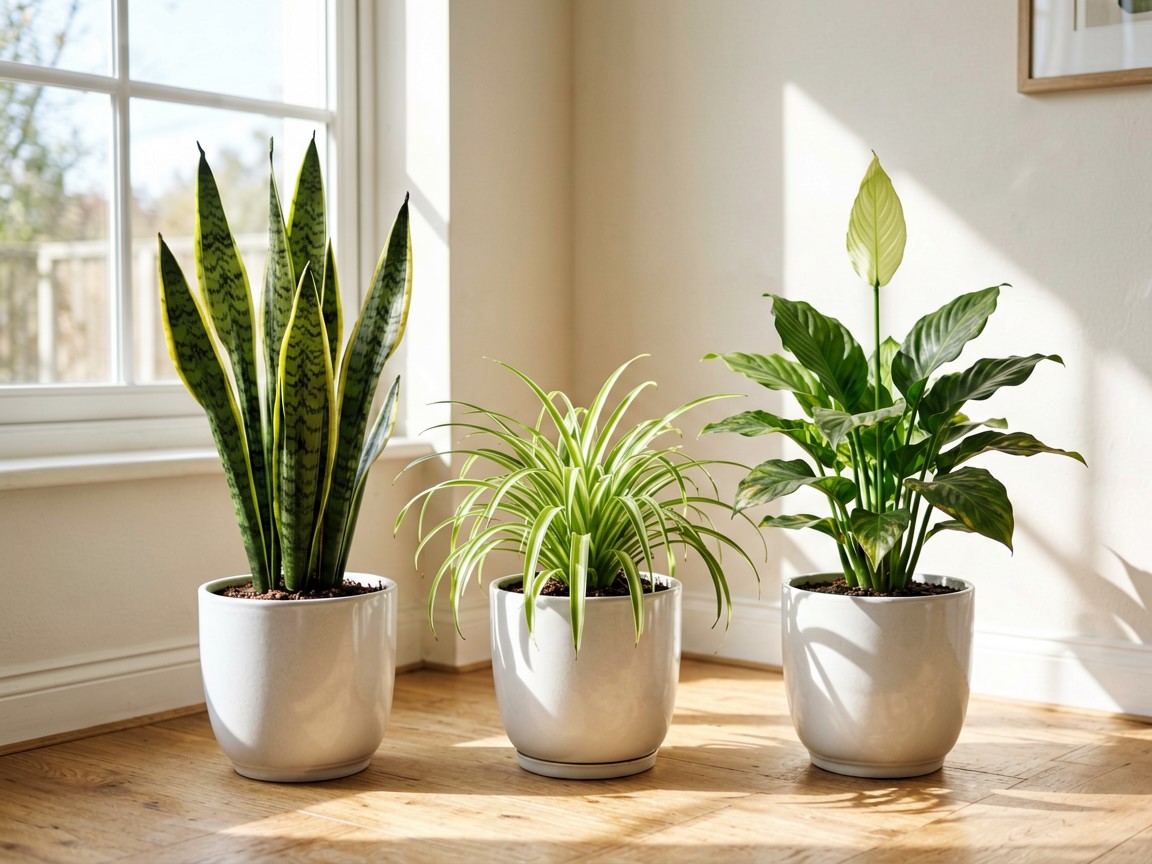
Costa Farms Snake Plant (4-inch, 8-12") is the closest thing to a set-it-and-forget-it air purifier you can buy. It removes formaldehyde and benzene, and uniquely converts CO₂ to oxygen at night — making it the top bedroom plant choice.
Why it wins in apartments:
- Water once every 2–4 weeks. Yes, that’s it.
- Tolerates low light to bright indirect. No window? Fluorescent light works.
- Grows 12–24 inches tall in a 4-inch pot; can reach 3–4 feet over years.
- Resistant to most pests.
Real talk: Overwatering kills snake plants, not underwatering. If your soil is still damp 2 weeks after watering, wait longer. The leaves will look slightly wrinkled when thirsty — that’s fine. They’ll plump back up after a drink.
Cat warning: Snake plants are mildly toxic to cats if chewed. Keep on a shelf or in a corner your pet can’t reach.
Best for: Bedrooms, dark corners, people who travel, absolute plant beginners.
2. ZZ Plant (Zamioculcas zamiifolia) — The Dark Corner Champion
ZZ Plant (6-inch, 12-18") is the only plant that genuinely thrives in spaces most others abandon. It’s native to eastern Africa’s dry, shaded forests — which means it’s evolved to survive months without water and plenty of shade.
Why it wins in apartments:
- Glossy, architectural leaves that look expensive.
- Survives 6+ weeks without water.
- Handles fluorescent office lighting and north-facing windows equally well.
- Removes formaldehyde, xylene, and toluene from indoor air.
Real talk: ZZ plants come with rhizomes (potato-like underground stems) that store water. These make the plant incredibly drought-resilient but also extremely prone to root rot if overwatered. The #1 mistake people make with ZZ plants is treating them like regular houseplants that need weekly water. They don’t. Wait until the soil is bone-dry, then wait a bit more.
Cat warning: Toxic to cats and dogs if ingested. Keep elevated.
Best for: Windowless rooms, bathrooms with poor ventilation, offices, people who forget to water.
3. Peace Lily (Spathiphyllum) — The One That Talks to You
Costa Farms Peace Lily (1-foot, flowering) is the only plant on this list that actively communicates its needs. When it’s thirsty, the leaves droop dramatically. Water it, and within hours they perk right back up. It also produces elegant white spathes (flowers) regularly — something most houseplants never do indoors.
Why it wins in apartments:
- Removes ammonia, benzene, formaldehyde, and trichloroethylene (the widest toxin spectrum of any common houseplant).
- Produces actual flowers indoors.
- The drooping signal means you literally can’t over-neglect it.
- Thrives in medium to low light.
Real talk: Peace lilies want more humidity than most apartments provide. If leaf tips brown, you’re either underwatering or the air is too dry. A simple pebble tray (ceramic dish with water and stones, pot sits on top — not in the water) adds localized humidity. Misting helps temporarily but isn’t a long-term solution.
Cat warning: Contains calcium oxalate crystals — toxic to cats and dogs. Keep out of reach. The drooping leaves actually make it tempting for curious pets, so be extra vigilant.
Best for: People who want a responsive plant, bathrooms, medium-light rooms, anyone who appreciates flowers.
4. Pothos (Epipremnum aureum) — The Trailing Fast-learner
Live Pothos Plants 4-Pack (4× 4-inch pots) gives you four varieties in one purchase — usually golden, marble queen, neon, and pearl & jade pothos. Each trails beautifully from shelves, hanging baskets, or bookcases. Pothos removes formaldehyde, benzene, and xylene.
Why it wins in apartments:
- Grows in virtually any light condition.
- Trails 6–10 feet — perfect for vertical space in small apartments.
- Incredibly easy to propagate: snip a stem with a node, put it in water, roots form in 1–2 weeks.
- Four-pack means you can experiment: one in the bathroom, one in the bedroom, one as a gift, one to propagate.
Real talk: Pothos is so easy to grow that the only way to “fail” is to drown it. Like snake plants, pothos prefers drying out between waterings. The leaves will droop slightly when thirsty but recover quickly. Variegated varieties (marble queen, pearl & jade) grow slower and need more light than golden pothos — don’t buy marble queen for a dark bathroom.
Cat warning: Toxic to cats and dogs (calcium oxalate). Keep trailing vines away from floor-level pets.
Best for: Shelving, hanging baskets, propagation experiments, renters who want to multiply their plants for free.
5. Spider Plant (Chlorophytum comosum) — The Pet-Safe Winner
Spider Plant (6-inch pot) is the #1 recommendation for pet owners who want air-purifying plants. It’s non-toxic to cats and dogs, removes formaldehyde and xylene, and produces adorable baby “spiderettes” that dangle from the mother plant — which you can snip and plant to create free clones.
Why it wins in apartments:
- Pet-safe (one of very few air-purifying plants that are).
- Adapts to any light level (bright indirect is best, but tolerates low).
- Fast-growing — fills a hanging basket in 2–3 months.
- Produces babies you can propagate indefinitely.
Real talk: Brown leaf tips are the most common complaint, caused by fluoride/chlorine in tap water. If your city water has noticeable smell or taste, use filtered or distilled water. The plant will otherwise grow aggressively with minimal effort. Spider plants also prefer being slightly root-bound — don’t rush to repot into a huge container.
Cat safety: Fully non-toxic. Cats may chew the leaves (they’re crunchy and mildly interesting), but it won’t harm them. Just trim back if your pet treats it like a salad bar.
Best for: Pet owners, hanging baskets, beginners who want something safe, people who like propagation.
6. Rubber Plant (Ficus elastica) — The Statement Piece
Rubber Plant (10-inch pot, Burgundy) is the plant you buy when you want something that looks like it belongs in an interior design magazine. Large, glossy, burgundy-tinged leaves make a bold visual statement that smaller plants can’t match. It removes formaldehyde and is particularly effective against xylene.
Why it wins in apartments:
- Dramatic visual impact — one plant transforms a room.
- Slow-growing but steady — stays manageable in a 10-inch pot for years.
- Wipeable leaves — dust them with a damp cloth monthly and they stay glossy.
- Tolerates typical apartment temperatures (65–75°F).
Real talk: Rubber plants are more demanding than snake plants or ZZ plants. They want consistent moisture (not soggy, not bone-dry), bright indirect light, and stability. Move a rubber plant from room to room and it will drop leaves — they don’t like change. Once you find a good spot, leave it there. Also, the sap is irritating to skin and toxic to pets, so handle with care.
Cat warning: Toxic to cats and dogs. The sap can cause oral irritation and vomiting. Not recommended for homes with curious pets unless placed high on a shelf or in a room the pet can’t enter.
Best for: Living rooms, corners that need visual weight, people who want a focal-point plant, stable environments.
Apartment-Specific Care Tips
Light assessment: Most apartments have less light than plant labels claim. “Bright indirect” means within 3–6 feet of a south-facing window. If your plant is in a north-facing room or 10+ feet from any window, stick with snake plant, ZZ plant, or pothos.
Humidity reality: Central heating in winter drops indoor humidity to 20–30%. Most tropical plants prefer 40–60%. If leaf tips brown or edges curl, you have a humidity problem. Solutions (ranked by effectiveness): pebble tray > humidifier > grouping plants together > misting (least effective, temporary).
Watering rule of thumb: Stick your finger 1–2 inches into the soil. If it’s dry, water. If it’s damp, wait. This single habit prevents 90% of houseplant deaths.
Drainage is non-negotiable: Every pot must have drainage holes. If your decorative pot doesn’t have holes, keep the plant in its nursery pot and place that inside the decorative one. Water the plant over the sink, let it drain completely, then put it back.
Start small: One or two plants, not six. Learn how your apartment’s light and humidity behave before expanding. A dead plant teaches you nothing; a thriving one teaches you everything.
Frequently Asked Questions
How many air-purifying plants do I need? The NASA study used roughly one plant per 100 sq ft. For a typical 500–800 sq ft apartment, 5–8 plants would theoretically help. But don’t treat plants as your primary air purifier — they complement, not replace, ventilation and filtration.
Do air-purifying plants really work? Yes, but modestly. In a sealed lab chamber, NASA plants significantly reduced VOC levels. In a real apartment with open doors, windows, and ongoing pollutant sources, the effect is smaller but still measurable. Think of them as a nice bonus, not an air purifier replacement.
Which is best for a cat owner? Spider plant is the safest choice. It’s non-toxic, easy to grow, and pet-proof. If you want more options, consider Boston fern or parlor palm (though neither is in this guide’s primary rankings).
Can I put these plants in the bathroom? Yes — peace lily, pothos, and spider plant all appreciate bathroom humidity. Snake plant and ZZ plant will survive but won’t thrive (they prefer drier conditions). Rubber plant generally doesn’t like bathroom humidity fluctuations.
What about grow lights? If your apartment has genuinely poor light (no windows, or only north-facing), a simple LED grow light ($15–$30) makes a dramatic difference. Place it 6–12 inches above the plant and run it 10–12 hours/day. Even snake plants and ZZ plants will grow noticeably faster with supplemental light.
Final Recommendation
If you’re buying your first air-purifying plant for an apartment:
- No pets, zero experience: Snake plant (B08P3W5LVY) — $18–$35 on Amazon. Buy it, forget to water it, it survives.
- Has pets: Spider plant (B0DCT581D2) — $15–$25. Safe, attractive, productive.
- Wants flowers: Peace lily (B07BC8W8KN) — $15–$30. The drooping leaves make it impossible to neglect.
- Wants maximum value: Pothos 4-pack (B09XWWKRQW) — $12–$25. Four plants, one price, infinite propagation.
- Wants a statement: Rubber plant (B08MCKN22H) — $25–$45. One plant, big presence.
All links above go to specific Amazon US product pages with our affiliate tag. Prices fluctuate but these are representative ranges for 2026.